
Water is the “quiet infrastructure” of everything we believe in; sustainability, circular economy, craftmanship, and more. It is quintessential for human life, as well as all beings on this planet –this is a common knowledge. Alas, the world is still far from making water issues our top priority. Nearly 75% of the world’s population lives in countries classified as water-insecure, especially Indonesia (UN University, 2026). This means that most of us do not have the access to safely managed water resources for consumption and/or sanitation. This fact alone should tell us that water-related risks are now systemic rather than marginal –more of us experiencing it than not.
For many decades, global policies and science think tanks have warned us of an escalating problem regarding the water crisis, and many have called to act. Now, the situation has escalated to a hilt. The word “crisis” no longer captures what is happening in many parts of the world. The use of a language is so powerful, it can suggest the meaning of a phenomenon and thus dictate the way we view it, and the way we find the solution. When we use “crisis” to address a problem, this suggests a temporary emergency followed by a return to normal situation through a series of mitigation efforts. Unfortunately, this is no longer the case.
If you look closely long enough to notice, you would see a pattern of anomaly; rising sea-level, flood, and extreme rain gave way to so many water disasters that gave way to serious implications such as food security. But at the same time, various parts of the world are experiencing water shortages. This is a phenomenon called wet drought –an unusual weather condition characterized by high rainfall despite the onset of the dry season (IPB University, 2025). This was caused by natural causes like El Nino and La Nina, as well as the Indian Ocean Dipole. But the effect we are feeling is multiplied because of one thing. The answer: Global Water Bankruptcy.
Now, think of a financial situation where all the money you have is almost gone, but since payday is near, you only experience the stress of having tight money for a few days and mitigate through this problem by spending extra wisely and finding a side job. After payday, you can recover from the previous problem. This is called a crisis. Now think of a situation where you lose your job and side job as well as all of your savings. There’s no way to go back to the financial stability situation you were in. This is called a bankruptcy. Now, replace the “money” with “water”, the “job” and “side job” with “water resources”, and the “savings” with “water storage”. So, while a crisis is a temporary and time-bound issue, a bankruptcy is a final state. Each has different characteristics, severity, and thus needs different solutions. Crisis management needs to shift into bankruptcy management.
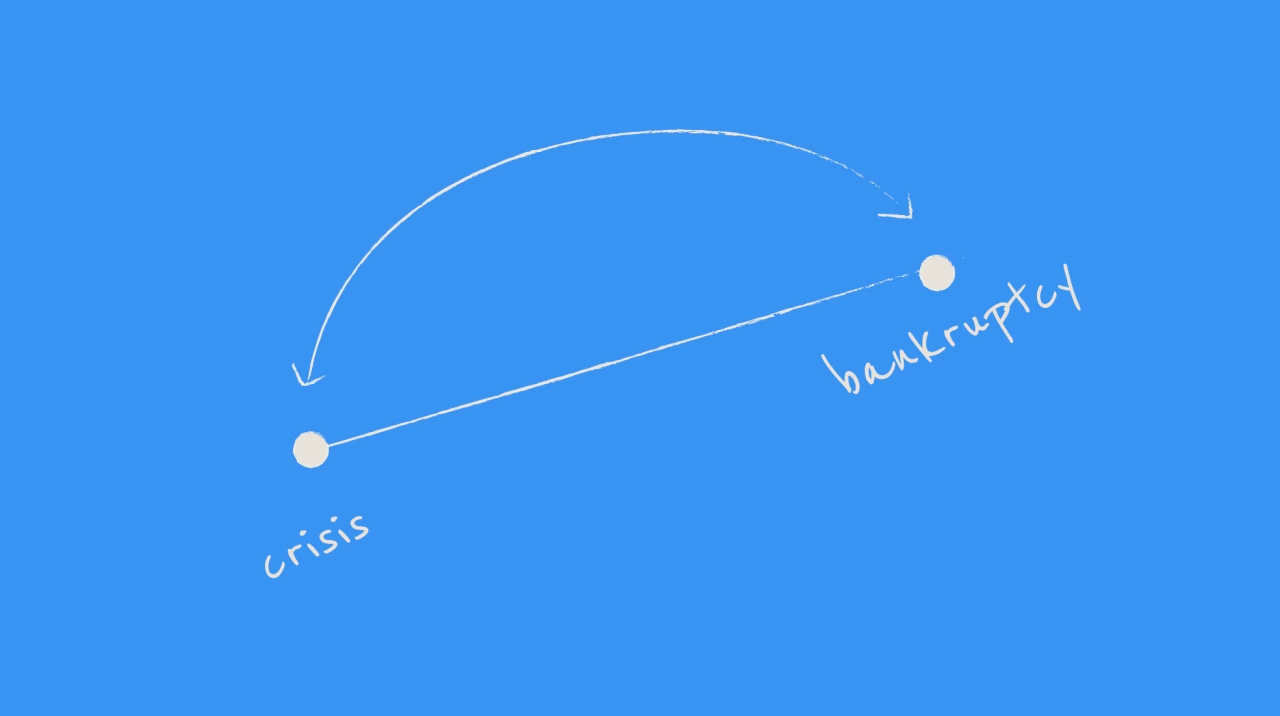
Back to our water problem; in a time of post-crisis, the global human water system as a whole has now entered the era of Global Water Bankruptcy. This means that the world is experiencing the point of no-return; water scarcity is unavoidable. Water bankruptcy is about both quantity and quality. This happens when we use water faster than nature can refill it. Final words : we almost have no water to sustain us. There are two problems that need to be addressed; insolvency and irreversibility. We need to tend to the issue of how we would survive the lack of water and establish a new system to adapt because returning to our old ways is no longer possible.
The problem is that industries still use water with the assumption of past natural conditions. New ways of manufacturing must be enforced. We need to shift to production methods with less water consumption. This is a grand step, one that can not be done instantly by one person. We need to collectively change. But one tiny little effort we can offer you is recycling. Recycling makes sure to reduce waste so water bodies like the ocean, lakes, and rivers are not polluted. Compared to virgin material production, recycling also consumes less water.
So, are you ready to embark on this new journey?


